
On 18 July 2026, Israeli occupation forces declared Husan, one of the villages in Bethlehem’s western rural area, a closed military zone. They imposed a comprehensive closure that effectively isolated it from its geographic surroundings, particularly from the neighboring villages of Nahalin and Battir. The measures extend to the closure of all main and secondary entrances to the village and the imposition of severe restrictions on the movement of residents and vehicles, disrupting all aspects of daily life inside the village.
The ‘Israeli Coordination and Liaison Office’ announced a series of military measures, including the designation of Husan as a closed military zone, the imposition of severe movement restrictions and a curfew, the prohibition of public gatherings, the closure of commercial shops, and restrictions on prayer at the mosque located near the bypass road. It also announced plans to conduct military operations inside the village, including house raids and the arrest of residents, which resulted in the arrest of a 15-year-old child so far. These measures were accompanied by a heavy deployment of occupation forces throughout the village’s neighborhoods, where the movement of vehicles and pedestrians was completely prohibited, and business owners were forced to close their shops. Israeli forces also raided one of the village’s mosques during dawn prayers, prevented the call to prayer and the performance of prayer, and forced worshippers to leave the mosque before firing sound grenades and tear gas in its vicinity.
These measures were also accompanied by intensified military control over neighboring villages, including the establishment of a new military checkpoint at the southern entrance of Nahalin, which Husan serves as its main access point, and the increased military presence on the road network connecting the villages of Bethlehem’s western rural area.
At the same time, the Israeli occupation authorities imposed a system regulating movement between the villages of Bethlehem’s western rural area. While residents of Nahalin were allowed to use the road leading toward the “Gush Etzion” settlement bloc, and certain routes remained open for residents of Battir, Husan residents were denied access to these roads. This system effectively isolated Husan from its geographic surroundings, obstructing residents’ access to workplaces, educational institutions, healthcare facilities, and essential services. As a result, the closure caused a near-total paralysis of daily life for more than 7,600 residents of the village and disrupted movement across Bethlehem’s western rural area more broadly.
Geographic and Settlement Context
Husan is located within the historic rural landscape of western Bethlehem Governorate, an area characterized by its traditional agricultural system, terraces, and historic water springs. It shares with neighboring areas, particularly the town of Battir, the same cultural and agricultural environment based on traditional agricultural terraces and water management systems, which form part of the cultural landscape inscribed on the UNESCO World Heritage List in 2014.
The village is located approximately 10 kilometers west of Bethlehem city. Under the classifications established by the Oslo II Accords, Husan’s lands were divided between Areas (B) and (C), which remain under full Israeli security and administrative control. This classification has subjected the majority of Husan’s lands to the Israeli planning and control regime, limiting residents’ ability to develop and access their lands and exposing them to land confiscation, settlement expansion, and the construction of military and settlement roads.
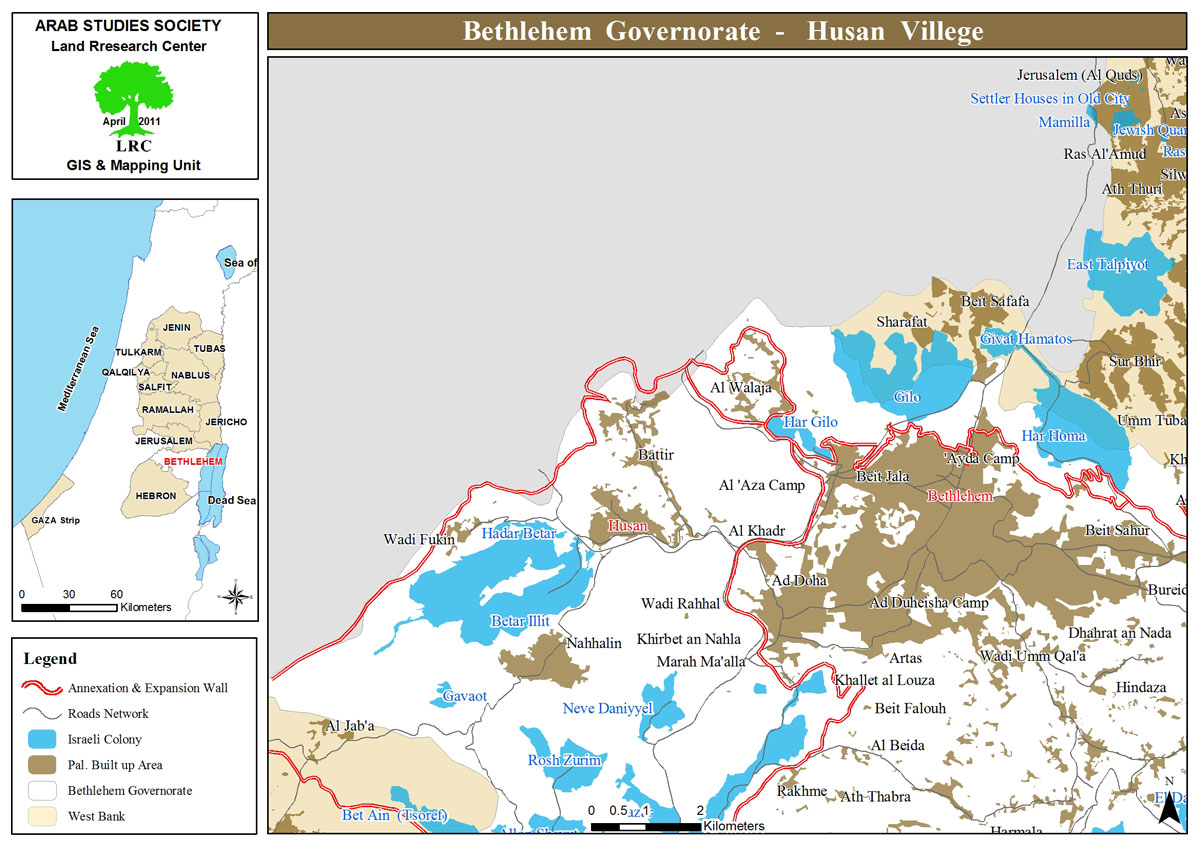
For years, Husan has faced repeated Israeli measures targeting its geographic structure and agricultural lands. Parts of its lands have been confiscated for Israeli settlements, including “Beitar Illit” and “Hadar Beitar,” while its lands have also been affected by the construction of bypass roads and the Annexation Wall. In April 2024, Israeli military bulldozers levelled approximately 100 dunams of agricultural land in the Al-Sharafa area at the eastern entrance of the village to establish a military road designated for Israeli military vehicles. This measure forms part of a broader pattern of control over agricultural lands and restrictions on residents’ access to them.
The comprehensive closure imposed on Husan in July 2026 does not constitute an isolated incident; rather, it forms part of a recurring pattern of military restrictions that have significantly intensified since 7 October 2023. During 2025 and 2026, the village witnessed repeated closures of its entrances, the establishment of military checkpoints, and restrictions on residents’ movement, resulting in its gradual isolation from its surroundings and obstructing access to workplaces, education, and essential services. Similar measures were imposed in April 2026 and June 2026, when Israeli forces carried out additional closures of the village’s entrances and intensified military restrictions in the western rural area of Bethlehem.
It is important to place the measures imposed on Husan within the broader pattern of the annexation of Bethlehem’s western rural landscape to the Green Line. The western rural area of Bethlehem, including Husan, Wadi Fukin, and Battir, holds strategic importance due to its location overlooking the western slopes of the Jerusalem mountains, making it a key area within efforts to consolidate territorial links between the settlement blocs south of Jerusalem and the city itself.
In this context, repeated closures, the isolation of villages, movement restrictions, and control over roads, alongside locally reported concerns regarding plans to annex or expand control over the western rural area, appear as part of a gradual process of annexation by strengthening Israeli territorial control and weakening the geographic continuity between Palestinian communities. These concerns stem from reported population mapping operations, including the collection of residents’ personal information, household data, and documentation of residential structures in Husan and Wadi Fukin.
Similar patterns have previously targeted residents, including the dissemination of messages through loudspeakers directed at residents of Wadi Fukin and Husan, reflecting the use of military measures to impose a new geographic and security reality on the area.
Legal Framework and Analysis
Husan village, located west of Bethlehem City, remains subject to the Israeli military control regime imposed over the occupied Palestinian territory since 1967. According to the classifications established under the Oslo II Accords, Husan’s lands were divided between Areas (B) and (C). Area (B) constitutes approximately 14% of the village’s lands and falls under Palestinian civil control while remaining subject to Israeli security control, whereas the majority of the village’s lands, approximately 86%, are located in Area (C), which remains under full Israeli administrative, security, and military control.
This division has placed the majority of Husan’s geographic area under the Israeli planning and control system, including control over land use, construction regulations, and road networks. As a result, the village has been continuously exposed to measures including land confiscation, settlement expansion, restrictions on access to land, and isolation policies linked to the surrounding military and settlement infrastructure, particularly due to its proximity to the “Gush Etzion” settlement bloc and the settlement-related routes connected to Bypass Road 60.
In its 2024 Advisory Opinion, the International Court of Justice affirmed the continued applicability of international humanitarian law and international human rights law in the occupied Palestinian territory and emphasized that Israel, as the occupying power, remains obligated to respect the rights of the Palestinian population under occupation. The Court further affirmed that measures adopted by an occupying power must comply with the principles of necessity, proportionality, and non-discrimination, and must not result in violations of the fundamental rights of the civilian population.
Within this context, the recent measures imposed on Husan, including the closure of village entrances, its isolation from its geographic surroundings, comprehensive restrictions on the movement of residents, disruption of commercial activities, interference with religious practices, prohibition of public gatherings, and the announcement of military operations inside the village, form part of a broader pattern of military restrictions that extend beyond temporary security measures and create conditions of geographic isolation and collective pressure on the civilian population.
These measures raise serious concerns under international humanitarian law, particularly the Fourth Geneva Convention of 1949, which obliges the occupying power to protect the civilian population and ensure respect for their fundamental rights. The comprehensive closure imposed on Husan, given its scope, its impact on the population as a whole, and its disruption of various aspects of civilian life, may amount to a form of collective punishment prohibited under Article 33 of the Convention, which prohibits imposing penalties or coercive measures against protected persons for acts they have not individually committed.
The restrictions imposed on religious practices, including preventing the call to prayer, obstructing dawn prayers, and forcibly evacuating the mosque, are inconsistent with obligations to respect freedom of religion and worship, including those established under Article 27 of the Fourth Geneva Convention and Article 18 of the International Covenant on Civil and Political Rights. Furthermore, restrictions on movement, the closure of commercial establishments, and preventing residents from accessing workplaces and essential services affect rights protected under international law, including the right to work and the right to an adequate standard of living.
When assessed cumulatively, these measures do not appear to constitute isolated or temporary actions, but rather part of a broader pattern in which military closures and movement restrictions are used as tools to control and reshape the Palestinian geographic space, strengthen control over areas adjacent to settlements, and impose disproportionate burdens on the Palestinian population, undermining their ability to exercise their daily lives freely and safely.
The recurrence of these measures, particularly since 7 October 2023, and their expansion throughout 2025 and 2026, indicate the use of closures and isolation as tools of collective pressure rather than responses limited to specific incidents. This raises serious concerns regarding their compatibility with the prohibition of collective punishment and the obligations to ensure freedom of movement and protect the civilian population living under occupation.