Recently, there has been a large escalation in demolition operations in the West Bank, demonstrating a systematic policy inseparable from broader patterns of control, erasure of Palestinian space, and Israel’s creeping annexation. In 2025, between 1 January and 30 September:
- 1288 Palestinian structures were demolished, displacing 1414 individuals and affecting 38017 others.
- 556 additional demolition notices were issued for residential, agricultural, and economic structures.
These figures indicate an unprecedented targeting of water and agricultural resources, particularly in the Jordan Valley, reflecting a deliberate strategy to eradicate livelihoods and thus, the very presence of Palestinians on their lands. The destruction of vital infrastructure, especially related to water and agriculture, has long-term consequences, effectively depriving entire areas of sustainable population capacity.
The Bethlehem Governorate, which holds the second-highest number of Israel’s demolitions, is witnessing a sharp increase in demolitions, notably in the eastern parts of the Governorate: Dar Salah, Al-Khas, and Al-Numan. According to data collected from the Dar Salah Municipality, the systematic demolition campaign that began in 2019 has now been intensified, targeting mass structures of different types and legal status. Only on 15 December 2025, the Israeli occupation delivered:
- 28 demolition orders at once; 2 demolitions have been executed until now
- Followed by 5 additional orders
- Targeting geographically and demographically interconnected areas: Dar Salah, Al-Khas & Al-Numan, and Wadi Al-Hommos.
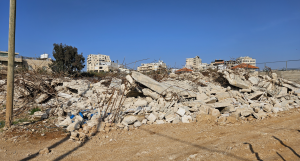
(BIHR – The remains of the home that was demolished in Dar Salah in June 2025).
The Israeli occupation authorities issued the demolition orders based on the following pretexts:
- Construction without permits for buildings in Area C
- Classification of the area as a “security restricted zone” due to proximity to the Annexation Wall for buildings in Areas A and B, located within a 200-meter buffer from the Annexation Wall and even beyond the designated buffer area.
The targeted areas fall within a geographic corridor between Dar Salah (east of Bethlehem) and Sur Baher (south of occupied Jerusalem), which previously formed a continuous geographic and demographic unit before being severed and fragmented by the construction of the Annexation Wall. This coercive intervention effectively re-drew spatial boundaries, separating otherwise contiguous Palestinian communities without any legitimate legal justification.
The legal paradox is that Sur Baher, located beyond the Annexation Wall, is entirely Palestinian in terms of population and built environment. Like Dar Salah, it was originally classified under Palestinian administrative control pursuant to the Oslo Accords. Yet its very existence beyond the Wall is invoked as a “security” rationale to justify demolition orders targeting Palestinian structures in Dar Salah.
This demonstrates that the Israeli “security” pretext serves as a flexible instrument imposed on reality to justify pre-planned demolitions. The Annexation Wall, declared illegal in the 2004 Advisory Opinion of the International Court of Justice (ICJ), transforms from an unlawful physical measure into a legal reference point upon which subsequent demolition and displacement policies are based. From an international law perspective, the issue is not rhetorical: Palestinian civilian presence cannot be considered a security threat in itself, while the illegal Wall is employed to redefine that presence as a threat.
Behind the Demolition System: Economic and Social Exhaustion Towards Forcible Displacement
Demolition policies extend beyond spatial threats, encompassing systematic economic and social exhaustion that effectively strips judicial remedies of their substance and effectiveness. According to the collected data:
- Legal representation costs in some demolition cases in a highly discriminatory planning system reached approximately 100,000 ILS (~31,499 USD),
- Minimum costs did not fall below 30,000 ILS (~9,449 USD).
Even when permits are verified, demolition orders are not rescinded, and cannot be rescinded under Israeli laws, but are merely postponed, without temporal or legal guarantees. Palestinian families, therefore, bear an excessive financial burden in exchange for a fragile temporary deferment, not substantive protection.
Demolition orders issued by the occupation authorities are not limited to residential structures but also target key social and economic infrastructure, including wedding halls, parking facilities, and public sports installations, most prominently, the Aida Refugee Camp pitch. These facilities cannot be categorized as secondary or “luxury” amenities; they perform essential functions directly tied to the rights to work, social life, and the healthy development of children and youth.
Such facilities serve as communal spaces, sources of direct and indirect livelihood, and rare safe areas in already crowded and spatially deprived environments. The Aida Camp pitch, serving over 250 children and around 500 youth, faces demolition despite the completion of all legal procedures, including formal lease arrangements.
Under the 1995 Oslo II Accord, the West Bank was divided into Areas A [1], B [2], and C [3]. Carrying out demolitions in Areas A and B signals Israel’s entrenchment of annexation, i.e., its intention to exercise sovereignty over the entirety of the occupied West Bank.
Legally and administratively, urban planning and construction regulation in Areas A and B fall under Palestinian Authority jurisdiction, requiring permits issued by competent Palestinian authorities. Issuing demolition orders in these areas is therefore not merely administrative interference but a direct violation of the Oslo-established legal arrangements.
Moreover, this interference is exercised as a systematic policy that empties the administrative classification of its substance, turning it into a formalistic framework used selectively to expand occupation authority beyond its declared mandate. Consequently, the area division ceases to function as a tool for temporary governance and becomes a means to reproduce colonial control under a legal pretext.
International Law
The systematic demolition orders in the West Bank, including Dar Salah and surrounding areas, constitute mechanisms for systematic forced displacement, demographic alteration, and annexation by an occupying power, explicitly prohibited under international law. Moreover, it violates fundamental human rights guaranteed to Palestinians as a protected population under international humanitarian law and international human rights law. These include the right to adequate housing, the right to health, the right to education, the right to family life, and the broader right to well-being. These rights are protected both collectively and individually and are essential for the dignity and survival of the Palestinian population as people with the inalienable right to self-determination.
According to principles in the Fourth Geneva Convention and interpretive guidance from the International Committee of the Red Cross (ICRC), forced displacement encompasses not only direct removal but also creating coercive conditions making civilian continuation in their homes practically impossible. Ongoing demolitions, economic exhaustion, and legal suspension of property status constitute a direct violation of Article 49 of the Fourth Geneva Convention, which prohibits forced transfer for reasons other than absolute military necessity.
The ICJ’s Advisory Opinion on the Wall (2004) confirms that constructing the Wall and associated restrictions on movement and property destruction constitute breaches of international law, and that security justifications do not legitimize destroying civilian property or altering demographic realities. The Annexation Wall, used as a “security pretext,” is, thus, an unlawful basis for further demolition orders.
Furthermore, under the Rome Statute of the International Criminal Court (ICC), the forced displacement of populations in a widespread or systematic attack constitutes a crime against humanity and may also constitute a war crime within the context of an armed conflict in occupied territory. The ICC recognizes coercive economic pressure and unlivable conditions as constitutive elements of forcible transfer, elements clearly present in the demolition policies and ongoing issuance of demolition orders.
The demolition policy and the legal apparatus governing it constitute a clear violation of the right to an effective judicial remedy, as legal procedures are emptied of their protective function and transformed into a formalistic path that neither prevents nor remedies harm. Even when construction legitimacy and permits are proven, demolition orders are merely suspended temporarily, keeping threats alive and undermining legal certainty.
The use of legal procedures as coercive tools forces Palestinian families into prolonged, costly litigation without clear legal horizons, generating economic exhaustion that renders the cost of staying higher than that of displacement. This practice indirectly pressures populations toward forced displacement, turning the judiciary from a protective mechanism into an instrument of systematic depletion, reshaping the demographic reality under a pseudo-legal guise.