Israel’s systematic, relentless expansion of its settlements in the occupied West Bank, coupled with the strategic use of environmental planning as a pretext to entrench this expansion, is currently a key mechanism for land fragmentation and demographic control throughout the occupied Palestinian territory. This approach centers on the coordinated activation of the “E1” and “E2” settlement corridors, along with nature reserves such as the “Nahal Og Nature Reserve”. These designations, presented as “environmental restrictions,” are used as a weapon of environmental protection to limit Palestinian urban development and justify land confiscation.
Advancing the “E1” Project and Northern-Central Division
The “E1” plan is a settlement project in Area C, which is under full Israeli control east of occupied Jerusalem. It is located between the settlements of “Ma’ale Adumim” and “Pisgat Ze’ev”. The plan borders several major Palestinian towns: Anata, Al-Issawiya, Al-Za’im, Al-Eizariya, and Abu Dis. It covers an area of 12 square kilometers east of occupied Jerusalem. Designed to sever East Jerusalem from its Palestinian hinterland, “E1” cuts across the center of the West Bank, effectively splitting its northern and southern regions. On August 18, 2026, the Israeli Ministry of Construction and Housing advanced this objective by issuing a tender for 1,234 housing units (out of 3,401 approved units). By setting an October 19 deadline, days before Israel’s national elections, authorities weaponized settlement expansion for political leverage. Furthermore, Israeli media reports indicate the tender proceeded without notifying the State Attorney’s Office, violating procedural commitments made to the Central Court and establishing legally binding commercial contracts that lock in irreversible facts on the ground.
The “E2” Project and the Encirclement of Bethlehem
The “E1” project is directly linked to the “E2” plan (known as “Givat Eitam”), which targets the southern area of the West Bank. This project is located south of Bethlehem, near the “Efrat” settlement bloc, and includes the construction of approximately 2,500 new settlement units to expand the “Efrat” settlement bloc at the expense of neighboring districts. While “E1” cuts off communication between the north and the center, “E2” completes the encirclement of the city of Bethlehem, isolating it from its southern countryside and the Hebron Governorate, thereby replicating the geopolitical impact of the “E1” plan at the level of the southern region.
The Strategic Bridge: Connecting “E1” and “E2” Through “Green” Constraints
Environmental classifications work in conjunction with settlement planning as a land management mechanism. By restricting Palestinian construction, agriculture, grazing, and infrastructure development in strategically located areas, they can preserve large contiguous areas for Israeli-controlled land use and facilitate future expansion or linking of settlement and infrastructure networks. Israel has already designated approximately half a million dunams of land in the West Bank as “nature reserves”, a designation that largely limits any Palestinian access to or development of such lands. These environmental designations are being used as a temporary cover for the subsequent transfer of land to settlement projects and occupation infrastructure. “The Nahal Og Nature Reserve” is of exceptional importance within this system, forming a strategic belt connecting expansion plans from the center to the south.
In 2022, the “Nahal Og Nature Reserve” was declared a vast area east of Jerusalem. It is considered the largest nature reserve in the West Bank in 25 years, and it extends across a wide area in the sloping basin from East Jerusalem and the vicinity of the “E1” plan, reaching the Dead Sea and Jericho. By declaring it a nature reserve and imposing “green restrictions,” any construction, agricultural development, or Palestinian water networks are “legally” prohibited. This declaration came at a time when urban development plans like “E1” were facing a freeze and intense international scrutiny. Through this environmental designation, Israeli authorities have quietly frozen Palestinian land use, stripped Bedouin communities of their lands, and designated the area stretching towards Jericho and the Dead Sea as a “closed state reserve” without any political uproar or conspicuous construction tenders. This prohibition aims to prevent any Palestinian urban expansion eastward, thus securing the settlement corridor for the E1 project and further isolating Jerusalem from Jericho and the Jordan Valley.
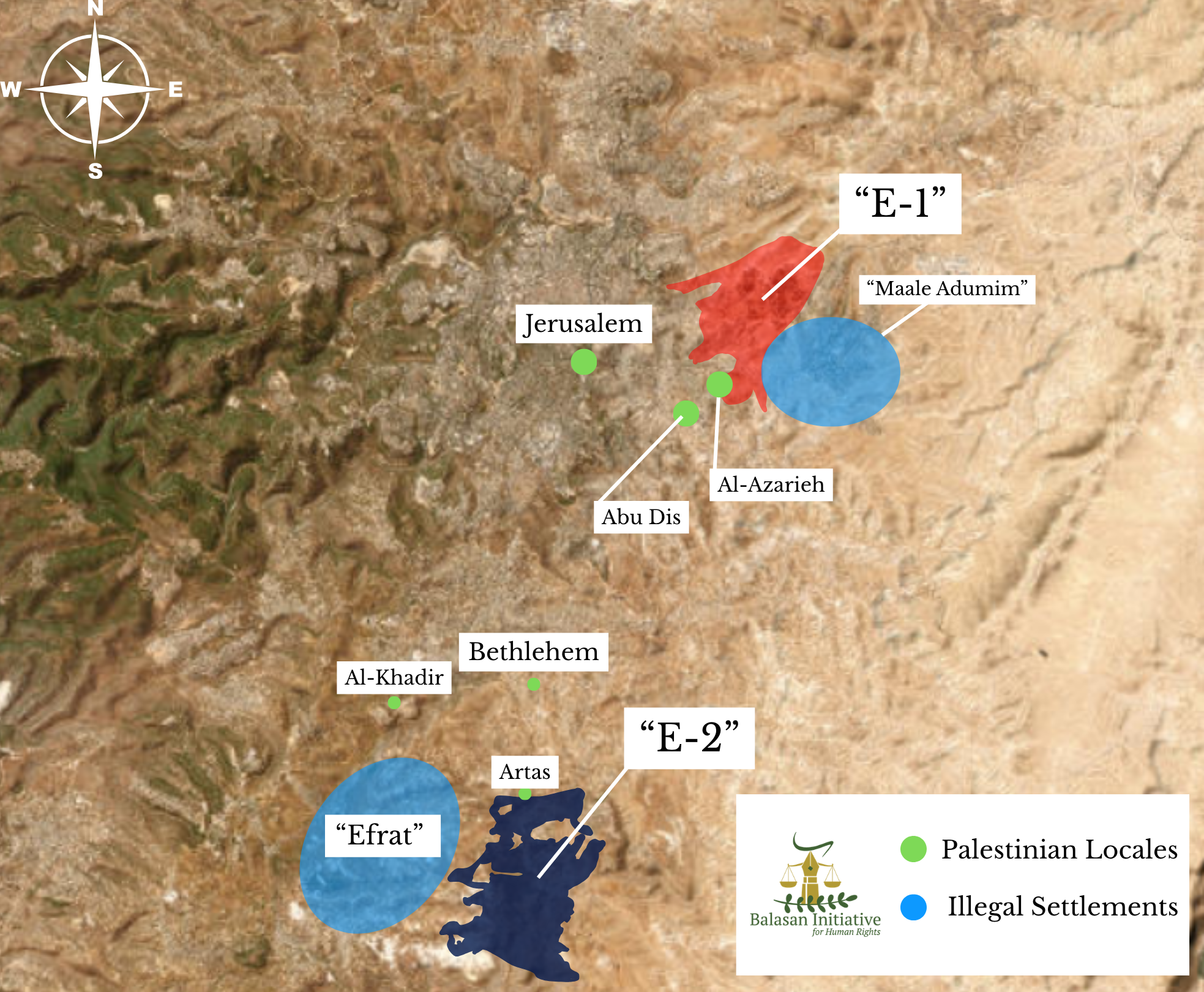
“Nahal Og” is not merely an isolated ecological zone; it forms the natural extension of the settlement belt that encircles the eastern wilderness of the Jerusalem and Bethlehem governorates. The reserve’s boundaries connect with strategic roads and routes that extend southward to meet the geographical area of the “E2” project. This encroachment eliminates any open spaces or land reserves that could have provided a geographical link between the central and southern West Bank. The designation of “Nahal Og” as a reserve allows for the confiscation of thousands of dunams and the depopulation of pastoral and Bedouin communities under the pretext of “protecting biodiversity.” These lands are kept as a closed strategic reserve, which Palestinians are prevented from entering, in preparation for their future integration into the highway networks and infrastructure that connect the “Ma’ale Adumim” settlement bloc (“E1”) with the “Efrat/Gush Etzion” settlement bloc (“E2”).
This reality effectively transforms the West Bank into two separate entities held together by a tenuous geographical thread. Forcing more than three million Palestinians to use a single route means that control over their geographical connectivity now hinges on the existence of that one road. By closing this gateway with a momentary security decision, the West Bank is immediately fragmented, the movement of people and goods is paralyzed, and the north is completely and rapidly isolated from the south.
Expanding the Illegal Economic Profits Off the “E1” and “E2” Projects
As noted above, Israel has already placed approximately half a million dunams of land under the “nature reserves” classifications, including the lands it controls in Khan al-Ahmar, where Palestinians are prohibited from cultivating or building. These lands are currently being used as bypass roads for settlers. These environmental designations are being used as a temporary cover for the subsequent transfer of land to settlement projects and occupation infrastructure. This movement includes the construction of a massive international airport in the area encompassing the “Nahal Og” reserve and the Nabi Musa area (located within Area C), with a capacity of up to 35 million visitors annually. It also includes the construction of a vast tourism infrastructure project comprising approximately 12,000 hotel rooms on land in East Jerusalem and the Jordan Valley. To connect this system, the project includes the establishment of industrial zones, an advanced road network to facilitate the movement of goods, as well as creating border Industrial zones with neighboring countries. While connecting the new airport to Ben Gurion Airport and the central station in Tel Aviv via occupied Jerusalem, as well as a series of tunnels connecting the Jordan Valley to Jerusalem and the high-speed rail line towards Tel Aviv.
Ultimately, these developments serve as the vital eastern and southeastern logistical extensions that consolidate and entrench the “E1” and “E2” settlements.
Furthermore, with the implementation of the “E1” project in the north and the “E2” project in the south, a closed geographical environment has been created, leaving Palestinians with only one route connecting the north and south. This also entails the increased displacement of Bedouin and rural communities from their lands in the north and south, confining the Palestinian presence to specific, non-expandable geographic enclaves.
Achieving the Goals of “Greater Jerusalem”
This spatial and corridor control produces the planned strategic outcomes. The “Greater Jerusalem” plan expands by annexing large settlement blocs “Ma’ale Adumim”, “Efrat” and the “Gush Etzion blocs” to connect them to West Jerusalem, making it the dominant urban center. The number of settlers in these areas is doubled while the Palestinian presence is stifled and reduced to its lowest levels. This intensifies forced displacement, as Bedouin communities and pastoral groups spread across the Jerusalem desert are uprooted and forcibly relocated to specific, besieged urban enclaves (such as al-Eizariya and Abu Dis). This effectively empties Area C and confines the Palestinian population to isolated, non-expandable residential pockets.
Legal Framework
The systematic use of road networks and settlement construction to fragment Palestinian territory and control population growth constitutes a clear violation of multiple international frameworks, including customary international law, international humanitarian law, international human rights law and UN resolutions, all of which Israel is bound to in its capacity as occupying power. The applicability of these multiple frameworks has been authoritatively confirmed multiple times by the International Court of Justice (ICJ). In its 2024 advisory opinion of, the ICJ ruled that policies of de facto annexation, discriminatory practices in the exploitation of natural resources and land, and the alteration of demographic characteristics and geographic location are illegal. The ICJ concluded that Israel’s very presence in the oPt is unlawful, and called on the international community to take measures to put it to an end.
Israel’s settlement policy in the occupied West Bank contributes to de facto annexation by extending permanent civilian settlement, territorial control and infrastructure into occupied territory, while facilitating the transfer of Israel’s civilian population into it. Such measures progressively integrate parts of the occupied territory into Israel and undermine the territory’s distinct legal status and the Palestinian population’s right to self-determination. Under international humanitarian law, an occupying power is prohibited from annexing occupied territory and from transferring parts of its own civilian population into that territory. The prohibition on acquiring territory by force is also a fundamental principle of international law.
As such, under the law of military occupation, the occupying power does not acquire sovereignty over the occupied territory, nor does it have the right to re-engineer the territory to serve its settlement, demographic, or economic interests. Article 43 of the Hague Regulations of 1907 stipulates that the occupying power is obligated to restore and ensure public order and civil life, while respecting the laws in force in the occupied territory. Article 55 also stipulates that the occupying power manages and benefits from public real property in its capacity as an administrator and beneficiary, and not as an owner or sovereign owner. Therefore, using occupied territories to bring about permanent territorial changes that serve the interests of the occupying power, including establishing settlements, linking them to infrastructure, and reallocating large areas of land, is inconsistent with the restrictions that the law of occupation imposes on the occupier’s authority.
Article 49(6) of the Fourth Geneva Convention prohibits the transfer of parts of the civilian population of the occupying power into the territory it occupies. This prohibition constitutes a fundamental basis for the illegality of the entire Israeli settlement project in the occupied Palestinian territory. Accordingly, the establishment and expansion of settlement blocs, including projects associated with the “E1” and “E2” plans, represent a direct continuation of this violation and cannot be treated as ordinary urban expansion. These projects not only add housing units, but also reshape the occupied land to serve Israeli settlement blocs and connect them to road networks and infrastructure at the expense of Palestinian regional connectivity.
United Nations Security Council Resolution No. 2334 of 2016 also affirmed that the establishment of Israeli settlements in the Palestinian territories occupied since 1967, including East Jerusalem, does not have any legal legitimacy and constitutes a flagrant violation of international law. The resolution affirmed that the international community does not recognize any changes occurring on the borders of June 4, 1967, including those related to the city of Jerusalem. Therefore, the expansion of settlements and the connection of settlement blocs via roads and infrastructure does not merely represent a change in land use, but rather establishes a regional and demographic reality through which Israel seeks to establish its control over the occupied land and impose permanent facts on it.
The policies of displacement and population exclusion constitute a further violation of international humanitarian law. Article 49(1) of the Fourth Geneva Convention prohibits the forcible individual or mass transfer or deportation of protected persons from occupied territories. Forced displacement is not limited to direct evictions; It can also result from the imposition of living and territorial conditions that make the survival of populations in their areas of origin impossible or unsustainable. In this context, restrictions imposed on construction, agriculture, grazing, access to land and water resources, infrastructure networks, and movement undermine the ability of Palestinian communities, especially Bedouin and herding communities, to continue on their lands, which directly contributes to their uprooting and regrouping in besieged urban enclaves.
These practices also violate international human rights law. Article 12 of the International Covenant on Civil and Political Rights (ICCPR) protects the right to freedom of movement, while Article 17 protects individuals against arbitrary or unlawful interference with their homes. Therefore, restrictions preventing Palestinian communities from accessing their land, sustaining their livelihoods, developing their residential areas, or establishing necessary infrastructure may infringe upon the rights guaranteed by the Covenant. At the collective level, Article 1 of both the ICCPR and the International Covenant on Economic, Social and Cultural Rights (ICESCR) recognizes the right of peoples to self-determination, including the right to freely dispose of their wealth and natural resources.
Taken together, these measures demonstrate how Israeli settlement policies not only affect individual rights, but also undermine the collective right of the Palestinian people to self-determination and the exercise of sovereignty over their land and natural resources, thus constituting a situation of multi-layered unlawfulness that merits immediate action in line with international law, owed and long overdue by the international community to the Palestinian people.
Sources:
The Minister of Defense approved the declaration of the largest Nature Reserve in 25 years in the West Bank
https://hayat.ps/%D9%87%D8%A2%D8%B1%D8%AA%D8%B3-%D8%AA%D9%83%D8%B4%D9%81-%D8%B9%D9%86-%D8%AD%D9%8A%D9%84%D8%A9-%D9%82%D8%A7%D9%86%D9%88%D9%86%D9%8A%D8%A9-%D8%A7%D8%AA%D8%A8%D8%B9%D8%AA%D9%87%D8%A7-%D8%A5%D8%B3%D8%B1/
https://pchrgaza.org/e1-settlement-project-moves-into-implementation-stage-requiring-urgent-and-binding-international-action-to-stop-it/#a598bc06-60f3-44c5-8229-a6d5ab3dbd6d
https://www.eeas.europa.eu/eeas/statement-high-representative-israels-e1-west-bank-settlement-plan_en
https://www.aljazeera.net/encyclopedia/2025/8/15/%D9%85%D8%AE%D8%B7%D8%B7-%D8%A5%D9%8A-1-%D8%AE%D8%B7%D8%A9-%D8%A7%D8%B3%D8%AA%D9%8A%D8%B7%D8%A7%D9%86%D9%8A%D8%A9-%D9%84%D9%84%D8%AA%D8%BA%D9%8A%D9%8A%D8%B
https://www.aljazeera.com/news/2026/8/21/why-israeli-tenders-for-illegal-e1-west-bank-settlement-prompted-outrage
https://www.aljazeera.net/politics/2026/5/30/%D9%85%D9%86-%D8%A7%D9%84%D8%AE%D8%A7%D9%86-%D8%A7%D9%84%D8%A3%D8%AD%D9%85%D8%B1-%D8%A5%D9%84%D9%89-%D8%A7%D9%84%D9%81%D9%86%D8%A7%D8%AF%D9%82-%D9%88%D8%A7%D9%84%D9%85%D8%B7%D8%A7%D8%B1-%D9%85%D8%A7
https://alquds.com/ar/posts/255345-israel-tenders-1200-settlement-units-e1-jerusalem
https://www.wattan.net/ar/news/373246.html
https://palinfo.com/news/2017/12/27/89595/
https://balasan.org/israels-e2-plan-relentless-settlement-expansion-and-settler-violence/
https://imeu.org/resources/key-issues/fact-sheet-israels-e1-settlement/129
https://english.wafa.ps/Pages/Details/174078
https://felesteen.news/post/185271/%D9%85%D8%B4%D8%B1%D9%88%D8%B9-e1-%D9%87%D9%84-%D9%8A%D8%AA%D8%AD%D9%88%D9%84-%D8%A7%D9%84%D8%A7%D8%B3%D8%AA%D9%8A%D8%B7%D8%A7%D9%86-%D8%A5%D9%84%D9%89-%D8%A8%D9%88%D8%A7%D8%A8%D8%A9-%D9%84%D8%B9%D9%82%D9%88%D8%A8%D8%A7%D8%AA-%D8%A7%D9%82%D8%AA%D8%B5%D8%A7%D8%AF%D9%8A%D8%A9-%D8%B9%D9%84%D9%89-%D8%A7%D9%84%D8%A7%D8%AD%D8%AA%D9%84
https://poica.org/2005/05/e1-plan-a-step-toward-a-dead-end/